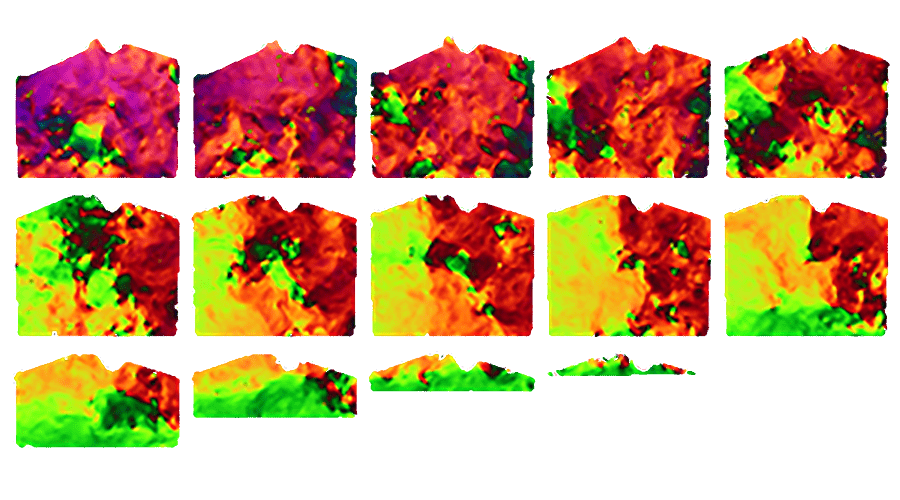
Analyzed flow fields inside an internal combustion engine with self-supervised deep learning models to gain insight into cycle-to-cycle variations.
Paper
D. Dreher, M. Schmidt, C. Welch, S. Ourza, S. Zündorf, J. Maucher, S. Peters, A. Dreizler, B. Böhm, A. Hanuschkin.
Deep feature learning of in-cylinder flow fields to analyze cycle-to-cycle variations in an SI engine.
International Journal of Engine Research 22(11), 3263–3285, 2021.
doi:10.1177/1468087420974148
Free full text: TU Darmstadt repository.
In short
- Data: a large set of in-cylinder flow fields from an optical spark-ignition engine, measured with high-speed particle image velocimetry.
- Method: deep convolutional autoencoders, trained self-supervised, compress each flow field into a low-dimensional latent space. Classifiers on those learned features predict whether a cycle will reach high or low peak pressure. No manual feature engineering needed.
- Result: high-energy cycles can be identified from the flow field as early as 290° crank angle before top dead center, with accuracy comparable to baselines built on an extensive set of hand-engineered features.
- Insight: feature analysis points to the horizontal velocity component of the in-cylinder flow as especially important for predicting engine performance.